




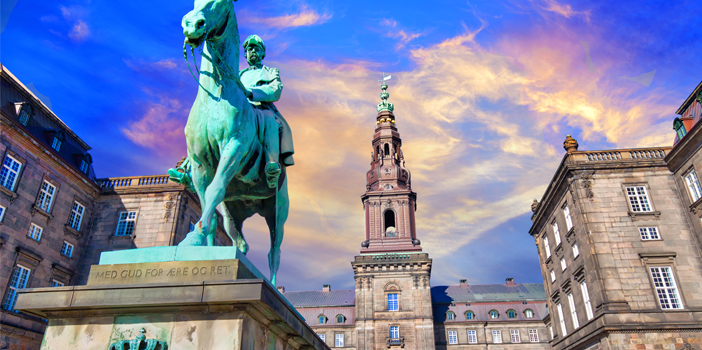
How often are parliamentary elections?
In Denmark, the law states that there must be a parliamentary election (’folketingsvalg’) at least once every four years. However, it often happens more frequently than that. It is the prime minister (‘statsministeren’) who decides when the election is.
We also have local and EU elections. This article is not about those, but only about the elections to the Danish parliament – Folketinget.
Why does Denmark have so many political parties?
Good question. Some parties are very old. Det Konservative Folkeparti (The Conservative People’s Party), Radikale Venstre (The Social Liberal Party), Socialdemokratiet (The Social Democratic Party) and Venstre (The Liberal Party) are all over 100 years old.
However, Denmark also has a tradition for new parties that goes back many years. Some parties stick around for decades and end up becoming major players. Others quickly dissolve again. It creates some dynamism and offers some surprises in every election.
Why is the party named Venstre not left-wing?
When Venstre (literally ‘Left’) was founded, it was in strong opposition against Det Konservative Folkeparti, who back then went under the name of Højre (‘Right’). That’s why the name Venstre was chosen. Times have changed and so have concepts of right and left in politics, but the name has stuck.
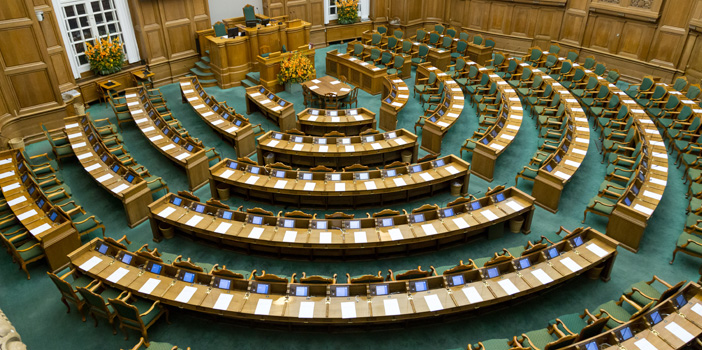
Who can vote?
Danish citizens over the age of 18 who have permanent residency in Denmark, Greenland or the Faroe Islands. Read more details on the website of Denmark’s parliament here: Who can vote? (in Danish).
How does voting work?
Denmark does not have digital voting, it is all done with pen and paper!
You can vote in person on election day, often in the gym of a local school.
Voting can also be done in advance. This is called ‘at brevstemme’ (‘to vote by letter’). It can be done in places like Borgerservice (citizen service centre).
People who live in crisis centres, homes for the elderly or who are prisoners can also often vote early in those places. In some countries, you lose your right to vote if you are convicted of a serious crime, but this is not the case in Denmark.
Danes living abroad can vote early in Danish embassies and consulates.
Who can I vote for?
You can only put one X on the ballot. You can put it in the box next to the name of a party or a candidate.
Read more details on the website of Denmark’s parliament here: How to vote (in Danish).
Is my vote private?
Yes. You do not have to tell anyone how you vote, and you will have a private space where you can write your vote and fold it before you hand it in. That way, no one can see how you voted.
Of course, you are free to tell anyone how you vote. But you never have to.
How are the votes counted?
Once the polls close on election day (usually at 20:00), the counting starts! Votes are counted proportionally. This means that we have to wait until all the votes are counted until we know for sure what parties, and what politicians, have got elected.
Usually this happens sometime during the same night, but if the election is tight, it can take a long time to get the final count.
How is the government formed? And what does it have to do with the King?
Once the votes are counted, we know how many mandates (‘mandater’), or members of parliament, each party has. But this is not the end!
Because there are so many parties, there is not one party that gains a majority alone. This means that the road to forming a government in Denmark is a little peculiar, and it involves the King!
Now starts something called a ’kongerunde’ (’King’s round’): Spokespeople from each party take turns visiting the King and telling him who they’d like to lead negotiations for the formation of a new government.
Historically, other parties have usually pointed to the leader of either Socialdemokratiet or Venstre to lead negotiations. But it doesn't have to be one of those.
The person that the majority selects gets the title of ’kongelig undersøger’ (’royal investigator’), which means that they are entitled to lead negotiations for forming a government.
If the negotiations fail, there is a new ’kongerunde’. And this can continue until a government is in place.
The King does not decide who gets to be the ‘royal investigator’. But this is one of the quirky traditions that come with having a constitutional monarchy such as Denmark’s.

Why is it hard to count to 90?
For many people learning Danish it IS hard to count to 90 because Danish numbers are so tricky.
But when we talk about ’at tælle til 90’ (’counting to 90’) in politics, it refers to the fact that a government needs the backing of at least 90 members of parliament. The Danish parliament has 179 members, so 90 is just exactly a majority.
Out of the 179 members of parliament, 2 are elected in Greenland and 2 in the Faroe Islands. Sometimes, they end up playing a crucial role in who gets to form a majority, so keep an eye out for that.
What can we expect after a government is formed?
A new government can mean many things:
- It can mean new parties are in charge
- It can mean new ministers
- It can even mean a new prime minister
- It might also mean new ministries getting formed – for example, after the election in 2022, a ministry for digitalisation was formed for the first time
We won’t know for sure. Sometimes you can have new parties in government but the same prime minister. It all depends on what the different parties end up negotiating.
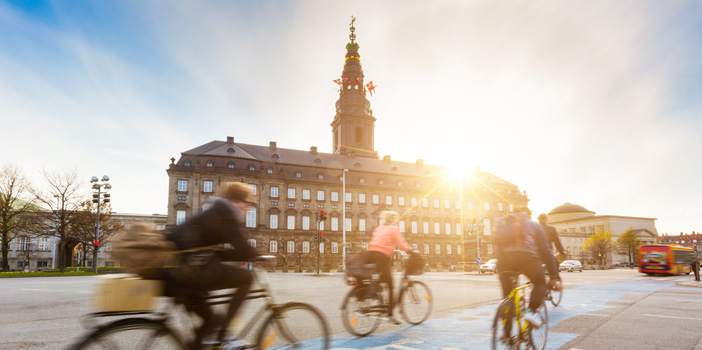
Should I expect big changes as soon as a government is formed?
Probably not. While a new government always has many goals, everything has to go through parliament and be formally voted for there, so there is still room for negotiations.
Danish parliament also has a tradition for wide coalitions, so often laws are negotiated between many parties, not just those in government.
When will the next election be?
There will be another election when the prime minister calls for one. This can be done at any time. Either because the prime minister wants to, or perhaps because he or she feels pressured to do so by a majority in parliament.
At the very latest, however, there must be a new parliamentary election 4 years after the last one.